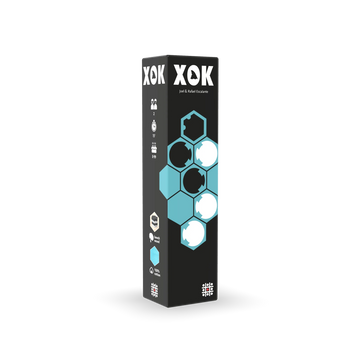
What changes from one FlexiQ game to the next
A position can change after an action, giving a new meaning to the available choices. The FlexiQ games in the Helvetiq catalogue invite you to explore mechanisms that are revealed one by one. To choose, look at the objective, the moves, and the players announced. A box may attract you with its shapes or colours. The rules then help you understand what the players will do and the decisions they will want to compare during the game.
Orbito and Strategeti each offer two distinct two-player game paths. Their unique components and objectives create entirely different experiences. You can choose the path that best suits the type of situation you enjoy observing: whether that is alignment, movement, or the relationships between elements. Take the time to read the descriptions. The brand name serves as an entry point into the selection, while the product's specific features help you confirm your interest.
Orbito: alignment on a moving board
Orbito is for two players aged 7 and up, with a playing time of 15 minutes. You’re trying to line up four marbles on a four-by-four board. Press the central button and the marbles move one position. The rules also let you move one of your opponent’s marbles to an adjacent space. Before placing a marble, consider how the next move will change the board for both players.
In a game where the position changes, it’s not always sufficient to simply look at the immediate surroundings to understand the consequences of one’s choices. You need to consider what seems to be the result of those choices, and then compare that to the actions that will follow, according to the rules of the game. This way of analyzing a situation is part of the enjoyment of discovery. The first step is to see how the situation works in action, with enough time to ask questions and understand the effects of each action.
To present Orbito, start by explaining the purpose of the alignment process. Then, demonstrate an action using the board. Participants can connect the rules to a visible change. Finally, refer to the necessary details for the execution of the activity. The materials provide a concrete basis for the explanation, but they don’t replace the need to read the instructions carefully. A well-prepared discovery process allows everyone to explore their own options and try out different ideas, rather than trying to anticipate every situation from the very beginning.
Strategeti: animals and multiple ways to conclude the game
The “Strategeti” is designed for two players, and it’s suitable for players aged 7 and above. Its four-by-four-square board allows for two levels of gameplay. The pieces represent elephants, lions, gazelles, and zebras, and their movements are based on the characteristics of these animals. The objectives are achieved by forming a sequence of four identical pieces, eliminating five enemy pieces, or blocking certain spaces. This game provides another way of observing the possibilities and interactions between the various elements involved.
To compare Strategeti with Orbito, first consider the actions and objectives involved, rather than just the visual similarities between the two. A common interest in alignment can lead to different rules and approaches. The way decisions are made changes depending on the movements and conditions at the end of the process. You can choose the proposal that interests you the most, and then prepare for the discovery process by gathering information about the product. The key is to create something that you both want to try together.
How to choose a FlexiQ game
Configuration and age
The number of players should be appropriate for your needs. A two-player game can be suitable for a match between an adult and a child, within the specified audience. It can also be used for games between adults. If you’re looking for another configuration, please check the references that specify this clearly. Don’t assume that the same number of participants will work for every game. Each set has its own specifications. It’s important to check these before making a choice based on the theme or equipment required.
The recommended age range is accompanied by other relevant characteristics. Orbito and Strategeti are suitable for children as young as 7 years old. This information applies to these two titles. When choosing a game for a child, also consider his or her habits and the people who will play with him or her. The enjoyment can come from a visible goal, an animal-themed world, or the discovery of rules. Look at what interests the child, and then consider the information that makes the proposed game suitable for the desired playtime.
Duration and discovery pace
The duration indicated in minutes helps to determine where the activity will fall within your available time. Also, plan for any explanations or setups that may be needed during the first session. Two players who already understand how the game works may not necessarily follow the same pace as a duo who is just learning how to play. Choose a time when both players can take a look at the rules and ask questions. Once the rules are understood, you can decide together whether you want to play again.
Observation and decisions during the game
To approach a game of position, consider the overall situation before focusing on just one possibility at a time. What actions are allowed? What have changed since the previous round? What goal do you want to achieve? These questions provide you with a framework within which you can make decisions. You can compare different options without immediately trying to find a complete solution. The discovery process also involves the attempts and reactions of your partner.
The process of decision-making takes a concrete form through the actions taken regarding the materials involved. One possibility catches your attention, while another counterargument changes the situation, and you then look again at the available options. To make a choice, you need to understand these actions involved in the process of selecting materials. The catalogue provides you with objectives, rules, and information about the materials available. Your preferences help you decide what you’re willing to explore. In this way, a box becomes useful through its functioning and the interactions it creates.
Discover at two in family
When a child plays with an adult, a simple explanation of the objectives provides a starting point for interaction. Demonstrate the actions involved, and then give time for the adult to make decisions on behalf of the child. The adult can remind the child of certain rules, but doesn’t make decisions for the child. In this way, each person can have a say in the decision-making process. Questions and attempts to find solutions are part of this new way of interacting, within the context of the announced rules and settings.
After the game, you can go back and reflect on situations that surprised you during the game. Did a change in position create any opportunities? Did an action make you want to try something different in the next game? These exchanges help to prolong the moment, without requiring all participants to engage in the same tactical thinking. Some people prefer the pace and the material itself. Others enjoy comparing different decisions. Both perspectives can be brought together around the same “box” of information.
Choose for adults or as a gift
A game for two people can be a great way to create a moment of discovery for friends, couples, or players who enjoy visual experiences. When choosing a gift, consider the recipient’s habits: does he/she often play with the same person? Does he/she prefer alignment or movement in the game? Then, consider the product’s features and functionality. A product that suits his/her preferences will give the gift a real meaning in his/her leisure time.
Compare the price in Swiss francs on the Swiss store’s website with the information provided in the product description. The dimensions of the product also play a role if you want to store or carry it with you. Check the language of the rules and other information provided in the product description. This helps in making an informed decision when choosing a product. You can then choose a product that meets your needs, and the recipient can easily imagine how they will use it.
Prepare your first FlexiQ discovery
Install the equipment so that both players can see the necessary information and can perform the required actions. Read the instructions carefully before starting. Then, present the objective clearly. An example can help visualize the effects of a particular action. Keep the rules nearby, so you can check the details. This preparation provides a common foundation, from which each player can discover the possibilities through their own perspective and rhythm.
If several references appeal to you, compare what specifically differs between them. Orbito features a platform where the balls move around. Strategeti, on the other hand, offers animations of moving animals and various conditions related to the ending of the game. Both options can be interesting for the same player, but for different reasons. Choose the option that makes you want to start playing right away. Then, let experience tell you what you’ll enjoy in each option.
Compare the tactical choices in Orbito and Strategeti
Look at what changes on the game board from one turn to the next. Orbito asks you to think about where marbles will move when the button is pressed. Another FlexiQ strategy game may ask you to read the board or respond to your opponent in a different way. Check the rules and player count to choose a game that gives your group the kind of tactical choices it wants.